
The size chart is no longer enough. Here’s what to do instead.
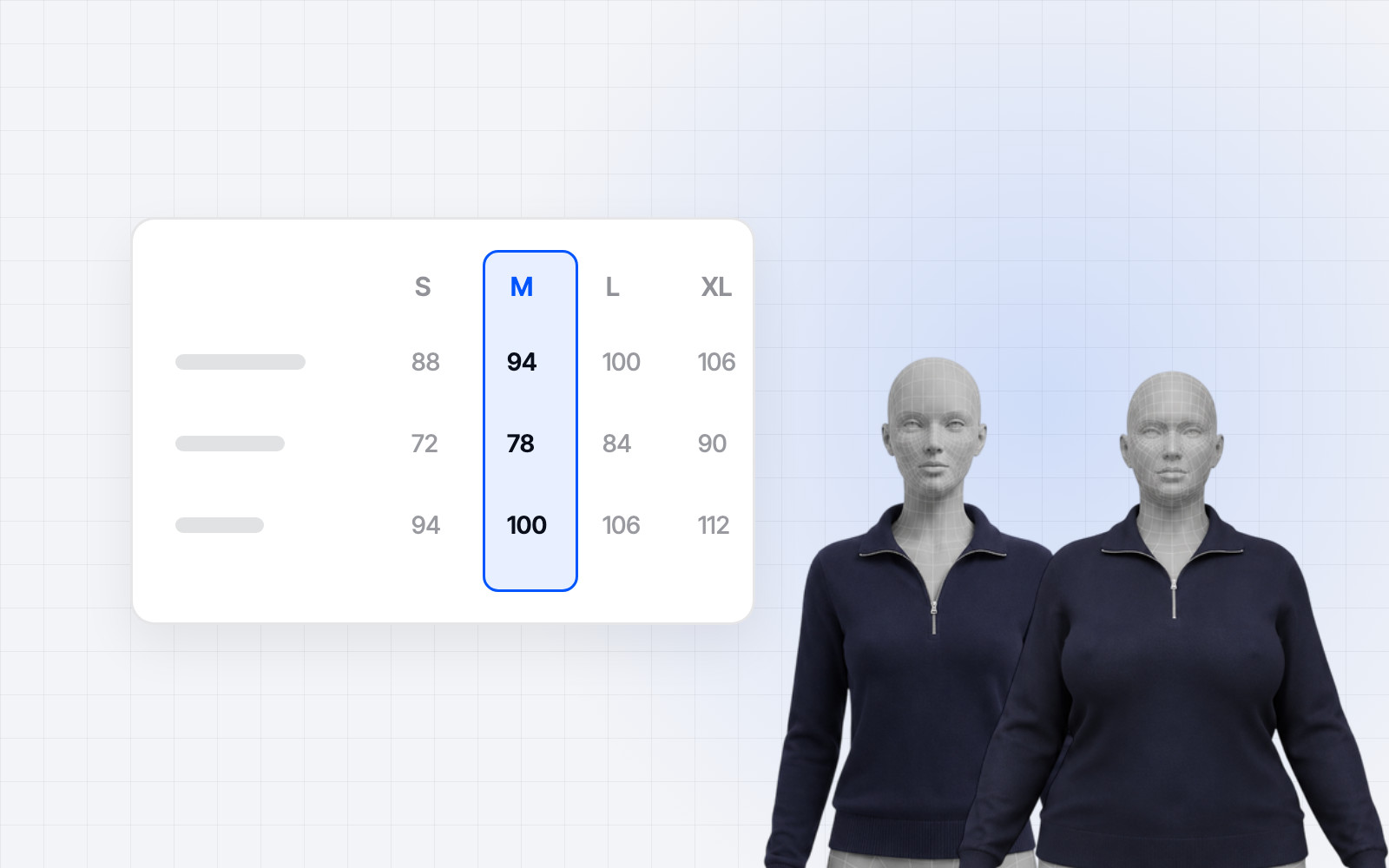
Size charts are still useful, but no longer enough. They give general measurements where the customer expects a personal answer: “for me, this specific garment, which size?” Between a table of centimetres and that answer, there is a gap. That gap is where sales get lost.
What a size chart does well
Let's be fair: a good size chart structures information. It sets the brand's correspondences, signals a serious store, and serves as a reference for customers who know their measurements and take the time to compare them.
Where it fails
The problem is everyone else. Most customers don't know their chest or shoulder measurements, don't have a measuring tape at hand, and won't interrupt their purchase to measure themselves. The table asks for work they will not do.
And even measured, the customer isn't safe: a 100 cm chest doesn't “behave” the same in a slim cut and a straight cut, in a rigid fabric and a stretch one. The table says nothing about the drape.
The same “M” never fits the same
A concrete example with two pieces from the same store: a slim-fit half-zip and a straight-cut jacket. The customer who swims in the M jacket can be tight in the M half-zip, same letter, different realities. That is why “I'll take my usual size” disappoints so often, and what no general table can fix.
From the table to a personal answer
The modern answer crosses the customer's data with each garment's real measurements, fabric and cut included: a recommended size, product by product, with a fit description. And for those who want to see before believing, virtual try-on shows the garment worn on their 3D digital twin.
Keep the chart, add the answer
This is not about removing your size chart: it keeps its reference role. It is about adding, right on the product page, the answer the chart cannot give.
How OptiDress addresses this
OptiDress provides that personal answer: the visitor enters their physical characteristics, without uploading any photo, sees the garment worn on their 3D digital twin and receives the recommended size for that specific product, with a fit description (OptiSize). The avatar is kept for 30 days on the store.
Integration takes under 24 hours on your existing store, with a subscription based on the number of monthly visitors, no commitment. Your size chart stays where it is.
Frequently asked questions.
Should we remove our size chart?
No. It keeps its reference role for customers who want to check precise measurements. The personalized recommendation complements it, for everyone else, which is the majority.
Our cuts are unusual (oversized, fitted, plus-size), does it work?
Yes, and that is precisely where generic recommendations fail: OptiSize starts from the real measurements, fabric and cut of each of your garments, not from a standard.
How long to add the recommendation to our store?
Under 24 hours, with no redesign: your product pages stay identical, the recommendation and the try-on are added to them.